
GE HealthCare has introduced an AI-enabled software application designed to help hospitals forecast capacity constraints up to three days in advance, as new federal data show emergency departments nationwide are seeing longer patient wait times. The company unveiled CareIntellect for Operations on September 15, positioning the tool to help health systems move from reacting to bed shortages and staffing gaps toward anticipating them before they cascade into larger disruptions.
HotSpot Take
GE HealthCare has launched CareIntellect for Operations, an AI-enabled SaaS application that analyzes patient and operational data to forecast hospital capacity constraints up to 72 hours in advance. It combines two proprietary AI models, one predicting resource pressure and one estimating patient discharge timing, then recommends specific actions to address bottlenecks in beds, staffing, and patient flow. The Queen’s Health Systems and Duke Health are the first clinical evaluation sites. The launch follows new CMS data showing emergency department wait times have climbed nationally, adding pressure to health systems already managing rising patient volumes.
Two AI Models, a 72-Hour Window
In a September 15 announcement, GE HealthCare said CareIntellect for Operations pairs two proprietary AI models it calls Pressure Forecast and Estimated Day of Discharge. Pressure Forecast draws on historical hospital operations data alongside real-time inputs from the electronic medical record and other resource management systems to predict constraints across hospitals, departments, and units up to 72 hours in advance, including census, staffing, and boarding and wait times in the emergency department, therapies, procedural recovery, and inbound patient transfers. Estimated Day of Discharge analyzes longitudinal patient data to predict when individual patients are likely to be discharged, updating its estimates hourly as new information becomes available.
Rather than stopping at prediction, CareIntellect for Operations then surfaces recommended actions and reprioritizes operational workflows, an attempt to help staff intervene in one unit before a bottleneck spreads system-wide. The Queen’s Health Systems and Duke Health will be the first clinical evaluation sites, providing frontline clinical and operational feedback that GE HealthCare says will inform future enhancements. At The Queen’s Health Systems, Chief Operating Officer Alex Wroe framed the initiative around patient access.
“We’ve seen firsthand how this type of advanced operational software can help us free up more capacity and better use our resources.” — Alex Wroe, Chief Operating Officer, The Queen’s Medical Center
“We’ve seen firsthand how this type of advanced operational software can help us free up more capacity and better use our resources,” Wroe said. “We look forward to taking this work to the next level, helping us move beyond reacting to capacity challenges and toward proactively ensuring that our beds, teams, and resources are available for the patients who need them most.”
A System Already Under Strain

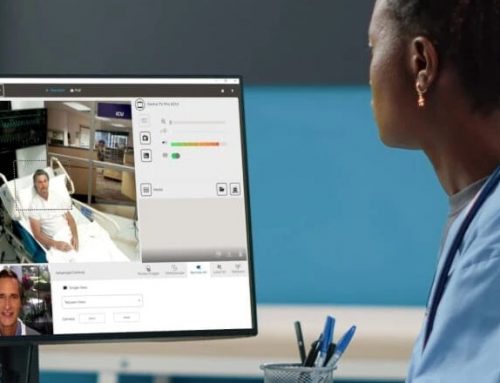
Hospital operations team reviewing real-time capacity dashboards. — AI-generated image.
The timing lines up with a broader operational squeeze on U.S. hospitals. CMS data covering the year ending September 30, 2025 puts the national median emergency department visit at 162 minutes, or roughly two hours and forty minutes, with wide variation by state; Maryland’s median exceeded four hours, more than double North Dakota’s. Meanwhile, the American Hospital Association reported that inpatient volumes rose 5.3 percent in 2025, requiring hospitals to treat more patients while often operating at or near capacity.
GE HealthCare frames those pressures, plus ongoing staffing shortages and rising costs, as the operational backdrop for the new application. Hospital leaders, the company says, can spend hours each day pulling and reconciling data from separate systems just to understand current conditions, often with little advance warning before a bottleneck fully forms.
“Managing demand and capacity across our system in a coordinated, predictable way is essential to delivering exceptional care,” said Katie Flanagan, associate vice president of patient flow and care coordination at Duke Health. “CareIntellect for Operations builds on three years of partnership with GE HealthCare, giving our teams a three-day view of what’s coming so they can move faster from analysis to action, for the benefit of our patients.”
Built on Two Decades of Command Center Data
CareIntellect for Operations is not GE HealthCare’s (Nasdaq: GEHC) first venture into hospital operations software. The application draws on more than two decades of experience from the company’s Command Center software, now used at nearly 500 hospitals and medical facilities globally. According to the company, Command Center customers have reported up to $20 million in first-year cost savings, more than a one-day decrease in average length of stay, and enough freed-up capacity to serve 19,000 additional patients annually in specific customer case studies it cites.
The new application also extends GE HealthCare’s CareIntellect family, a set of clinical and operational tools built on shared cloud infrastructure so customers can add applications without a separate integration project for each one. The company introduced its first CareIntellect application for oncology in 2024, aimed at consolidating cancer patients’ records and flagging clinical trial candidates; CareIntellect for Operations marks the family’s expansion into hospital-wide operational forecasting. It runs on Amazon Web Services and is available directly from GE HealthCare or through the AWS Marketplace. Since 2023, the company says it has invested more than $5.1 billion in innovation across its portfolio.
“Health systems need to know where pressure is building and what to do next.” — Dr. Taha Kass-Hout, Global Chief Science and Technology Officer, GE HealthCare
“Health systems need to know where pressure is building and what to do next,” said Dr. Taha Kass-Hout, global chief science and technology officer at GE HealthCare. “CareIntellect for Operations brings together patient and operational signals to give teams a 72-hour view of emerging constraints and help them act earlier.”
A Crowded Field for Predictive Operations
GE HealthCare is not alone in pitching AI-driven forecasting to hospital operations leaders. Qventus markets a platform of AI “teammates” aimed at automating tasks across perioperative, inpatient, and emergency department workflows. LeanTaaS takes a similar approach with its iQueue product line, including a generative AI layer called Autopilot, built around predictive capacity and scheduling for operating rooms, infusion centers, and inpatient beds. Like GE HealthCare, both Qventus and LeanTaaS argue that health systems already generate the data needed to predict operational strain but lack the tools to act on it fast enough.
GE HealthCare’s pitch leans on scale and incumbency: a Command Center installed base approaching 500 hospitals. Whether that translates into faster adoption of CareIntellect for Operations than a platform from a newer, operations-only entrant will likely depend on factors beyond the technology itself, including EMR integration effort and a health system’s appetite for another operations dashboard.
What a 72-Hour Forecast Means for Patients
CareIntellect for Operations remains in early clinical evaluation at two health systems, with GE HealthCare using that feedback to shape future versions before a wider rollout. The more consequential test beyond a pilot setting will be whether hospitals can act on a 72-hour warning quickly enough for it to matter. A prediction of tomorrow’s bed shortage is only useful if it changes what a charge nurse or bed manager does today.
The stakes for patients are straightforward. Longer emergency department waits and full inpatient units translate into delayed diagnoses, hallway boarding, and rescheduled procedures. Software that helps a hospital see a capacity crunch a few days out, and act on it, could mean fewer patients spending hours waiting for a bed to open.
— This original article was created with AI support.